Complete Guide to Importing Indonesian Seafood: Certifications, MOQ, Cold Chain & Compliance (2026)
印度尼西亚海产品进口完整指南:认证、起订量、冷链与合规(2026年)
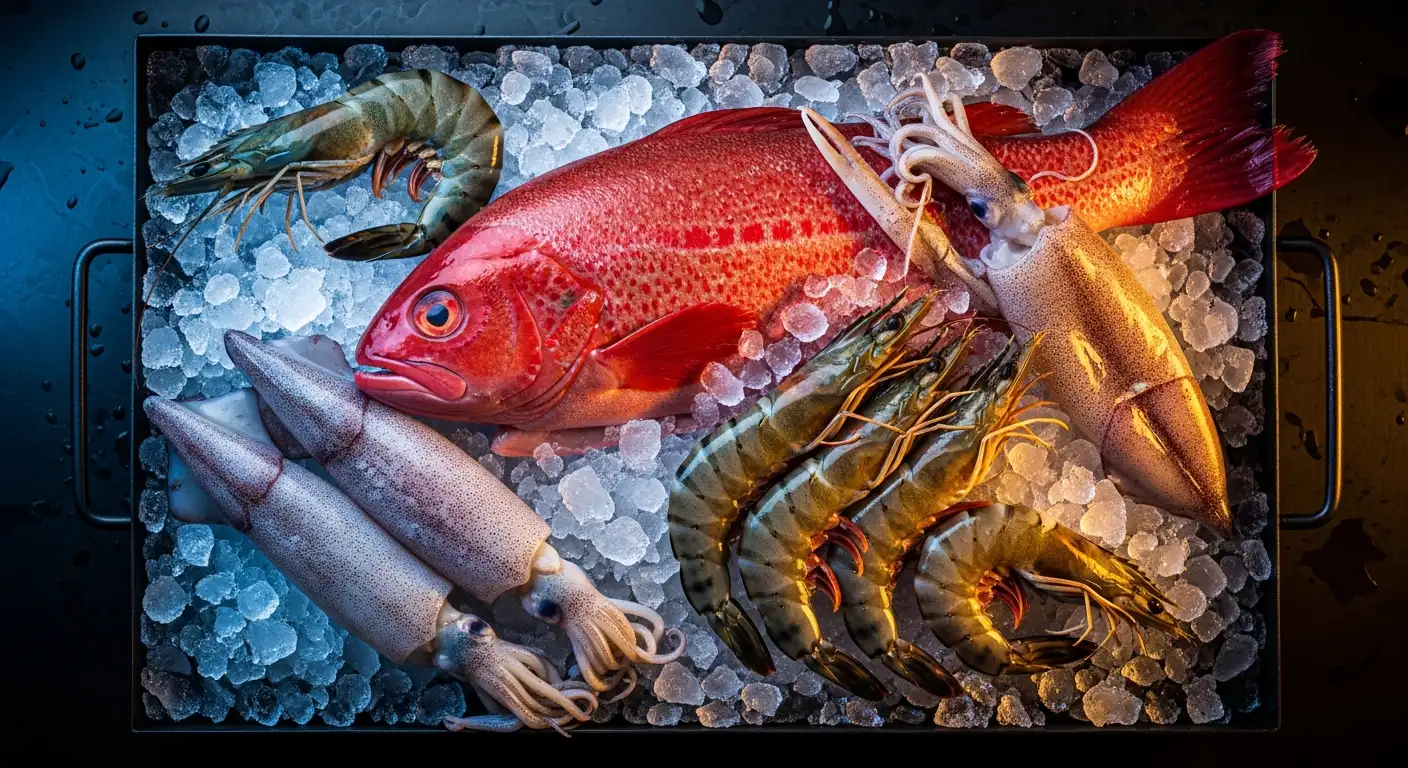
The definitive resource for international buyers sourcing Indonesian seafood. Covers supplier qualification, HACCP/BRC/Halal certifications, cold chain standards, import documentation, payment terms, and market-specific compliance requirements for China, EU, and the Middle East.
国际买家采购印度尼西亚海产品的权威资源。涵盖供应商资质评估、HACCP/BRC/清真认证、冷链标准、进口文件、付款条件及中国、欧盟、中东市场的特定合规要求。
- ✓Indonesian seafood exports cover 500+ species from one of the world's richest marine biodiversities. Key commercial exports: grouper, vannamei shrimp, loligo squid, Spanish mackerel, and snapper.
- ✓Mandatory certifications for most markets: HACCP (all markets), BRC Grade A (UK/EU retail), Halal MUI (Muslim markets), Health Certificate from BKIPM (every shipment).
- ✓Cold chain non-negotiable: IQF products must be maintained at -18°C throughout. Request temperature recorder printout and reefer pre-trip inspection with every shipment.
- ✓Standard payment for new buyers: 30% T/T deposit, 70% before BL release. LC at sight available for orders over 5MT.
- ✓China requires GACC registration for Indonesian seafood facilities. EU requires catch certificates and IUU compliance. Middle East requires Halal MUI plus country-specific certificates.
Why Indonesia Is the World's Premier Seafood Source
Indonesia's marine territory covers 5.8 million km² — the second-largest in the world. The nation's exclusive economic zone encompasses the Coral Triangle, the global center of marine biodiversity, where over 3,000 fish species have been documented. This geographic endowment makes Indonesia structurally positioned to be a major seafood exporter — not by infrastructure investment alone, but by natural advantage.
The FAO Fisheries and Aquaculture Report consistently ranks Indonesia among the top 5 global seafood exporters, with annual production exceeding 20 million metric tons (capture and aquaculture combined). Key commercially exported species include:
- —Marine fish: Grouper (5 key species), Spanish mackerel, goldband snapper, tuna, barramundi
- —Crustaceans: Vannamei shrimp, black tiger shrimp, mud crab
- —Cephalopods: Loligo squid, cuttlefish, octopus
- —Seaweed: Eucheuma cottonii, Gracilaria (dried and semi-refined carrageenan)
This guide covers everything an international buyer needs to know before placing a first order.
Part 1: Supplier Qualification — Due Diligence Checklist
Verify Legal Export Status
Indonesian seafood exporters must hold a valid Surat Persetujuan Ekspor Ikan (SPEI) — an export approval letter from the Ministry of Marine Affairs and Fisheries (KKP). This document confirms the company is registered and authorized to export fishery products. Request it before any commercial discussion.
Additionally, the processing facility must hold a separate operating license (SKU/Izin Usaha Perikanan) from the local fisheries office. A company may hold a trading license without a processing license — which means they are a trader, not a processor. Know which you are dealing with.
Certification Verification Checklist
| Document | Where to Verify | Validity |
|---|---|---|
| HACCP Certificate | [BKIPM Indonesia](https://bkipm.kkp.go.id/) | Annual renewal |
| BRC Food Safety | [BRC Participate](https://www.brcdirectory.com/) | 12-month audit cycle |
| Halal MUI | [LPPOM MUI](https://www.halalmui.org/) | 2-year cycle |
| MSC Chain of Custody | [MSC Database](https://www.msc.org/) | Annual audit |
| ISO 22000 | Certification body database | 3-year cycle |
Red flags during qualification:
- —Certificates without expiry dates or audit body names
- —BRC Grade B or below for retail supply chains
- —HACCP certificate issued by an unrecognized domestic body
- —Refusal to provide independent verification pathways
- —No traceability records from harvest to finished product
Site Visit Checklist
A factory visit (even a virtual tour via video) should cover:
- —Cold storage temperature monitoring systems (continuous logging, alarm systems)
- —Separation of raw and cooked product areas (HACCP critical)
- —Pest control logs and most recent audit report
- —Reject/rework procedures and product hold areas
- —Staff hygiene facilities and training records
TaMainco welcomes buyer visits to our Jakarta processing facility. Contact us to arrange.
Part 2: Product Specifications & Grading Standards
Marine Fish Specifications
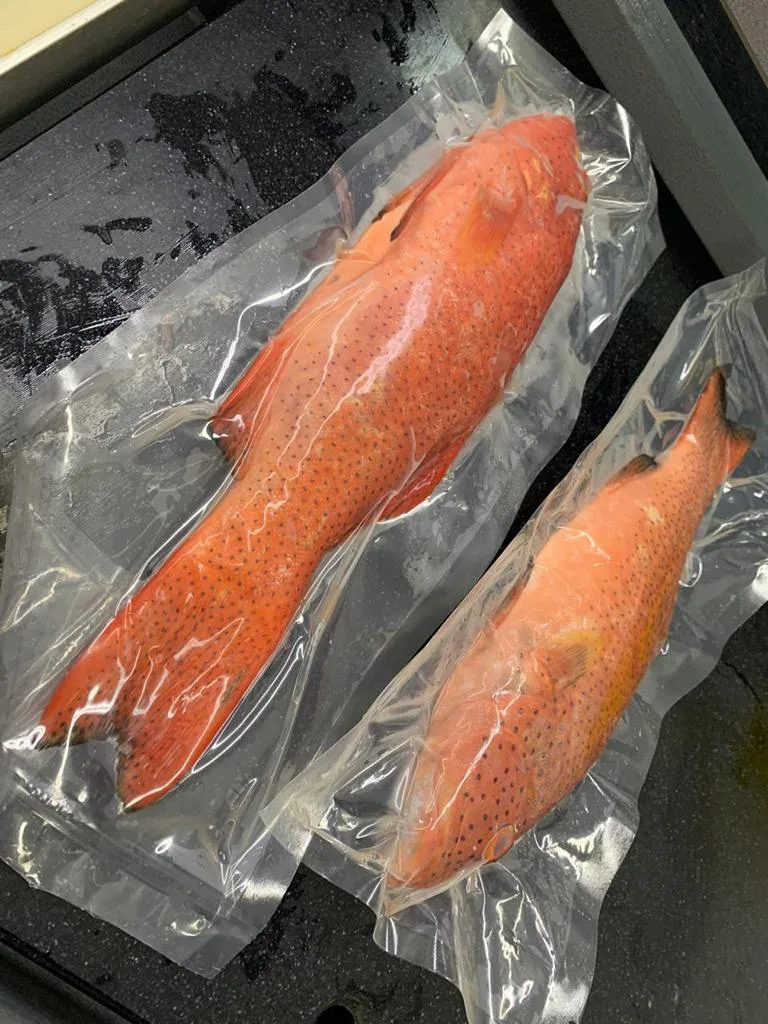
Red Grouper (Epinephelus akaara)
The benchmark for premium grouper export. Key specifications:
- —Live: 300g-800g per fish (Hong Kong live fish market standard)
- —IQF whole round (WR): 400g-2kg, gutted or round
- —IQF fillet: 100g-400g, skinless or skin-on
- —Color: bright red dorsal with white flesh, no bruising
- —Freshness: HACCP Grade A, H&G (headed & gutted) or WR
Vannamei Shrimp (Litopenaeus vannamei)
Indonesia's highest-volume seafood export commodity, accounting for approximately 40% of total seafood export value according to KKP export statistics.
- —HOSO (head-on, shell-on): 20/30, 30/40, 40/50, 50/60 count/kg
- —HLSO (headless, shell-on): standard for EU and US retail
- —PD (peeled and deveined): retail and HoReCa specification
- —PDTO (peeled, deveined, tail-on): premium retail specification
Spanish Mackerel (Scomberomorus commerson)
- —Round frozen: 0.5-2kg per fish
- —Fillet: 100-300g, skin-on or skinless
- —Steak cut: 2cm uniform thickness for Japanese and Korean markets
Spice Specifications (Agricultural Products)
| Product | Grade | Key Parameter | Standard |
|---|---|---|---|
| Cloves (whole) | Grade A | Eugenol ≥72%, moisture ≤12% | [ASTA](https://www.astaspice.org/) / SNI 01-3392 |
| Black Pepper | ASTA 550 | Bulk density ≥550g/L, moisture ≤12% | ASTA / SNI 01-0004 |
| Nutmeg (whole) | Grade A | Moisture ≤10%, no mold | SNI 01-3714 |
| Mace | BWP Grade | Moisture ≤10%, volatile oil ≥4% | ASTA / SNI |
Part 3: Cold Chain — From Harvest to Container
The Temperature Chain
Maintaining product temperature from harvest to container is the single most critical quality determinant for seafood. Per Codex Alimentarius Standard STAN 92, frozen fishery products must be kept at -18°C or below throughout distribution.
The critical links in the Indonesian export cold chain:
Harvest
- —Wild catch: Ice slurry vessels maintain 0-2°C during transit to shore (target: <8 hours for premium species)
- —Aquaculture (shrimp, grouper): Harvest-to-processing facility within 2-4 hours
Processing
- —Pre-cooling room: 0-4°C with 90% relative humidity
- —IQF tunnel freezer: -35°C air blast, product core temperature -18°C within 30 minutes
- —Cold storage: -22°C ± 2°C, with continuous monitoring
Container Stuffing
- —Reefer container pre-cooled to -20°C before loading
- —Container departure temperature confirmed via digital data logger
- —Time between storage and container door seal: <30 minutes
Documents to Request
- —Temperature recorder printout (continuous log, harvest to container seal)
- —Reefer pre-trip inspection report (container number, setpoint, seal number)
- —Time-temperature indicators on master cartons
Air Freight (Fresh-Chilled Products)
For fresh-chilled grouper, tuna, and premium crustaceans:
- —Product packed in insulated styrofoam master cartons with dry ice or gel packs
- —Temperature target: 0-2°C throughout
- —Maximum shelf life from harvest: 7-10 days (species-dependent)
- —Routing: typically via Singapore, Hong Kong, or Guangzhou hubs
- —Consignee must have cold storage reception capability for immediate unloading
Part 4: Import Documentation — Complete Checklist
Every Indonesian seafood shipment requires a set of export documents. The specific set varies by destination, but the universal baseline is:
Universal Documents (All Markets)
| Document | Issuing Party | Purpose |
|---|---|---|
| Commercial Invoice | Exporter | Customs valuation |
| Packing List | Exporter | Cargo description |
| Bill of Lading or Airway Bill | Carrier | Proof of shipment |
| Certificate of Origin (Form D/E) | Indonesian Trade Ministry | Preferential tariff (ASEAN/RCEP) |
| Health Certificate (Sertifikat Kesehatan) | [BKIPM](https://bkipm.kkp.go.id/) | Seafood safety clearance |
| Certificate of Analysis (COA) | Accredited lab | Microbiological and residue test results |
China-Specific Requirements
China's General Administration of Customs (GACC) has significantly tightened Indonesian seafood import requirements since 2020:
- —GACC Registration: The Indonesian processing facility must be registered in GACC's seafood facility database. Unregistered facilities cannot export to China.
- —CIQ Inspection: Chinese inspection authorities conduct physical inspections at port of entry
- —COVID-era cold chain certificate: While formal requirements have relaxed, documentation of temperature compliance remains expected
- —Labeling: Chinese-language labeling on inner and outer packaging is mandatory
EU/UK Requirements
- —IUU Catch Certificate: Indonesia must submit catch documentation under the EU IUU Regulation (EC 1005/2008). Contact BKIPM for the catch certification process.
- —BRC or equivalent: UK/EU retail chains typically require BRC Grade A as a minimum
- —Residue monitoring: EU MRL (maximum residue limits) for antibiotics and heavy metals are strictly enforced. Request COA with specific EU panel testing.
- —Country HS code and import duty: EU Common External Tariff for fish and seafood ranges from 0% (tuna for canning, ACP origin) to 12% (frozen shrimp, MFN rate). Indonesia qualifies for GSP+ for some categories.
Middle East (GCC) Requirements
- —Halal MUI certificate: Mandatory for all GCC states. The certificate must cover the specific processing facility and product line.
- —Country of origin marking: Arabic-language country of origin labeling required for Saudi Arabia, UAE, and Kuwait
- —SASO (Saudi) / ESMA (UAE): Product registration may be required for certain processed categories
- —Health certificate from KKP: Recognized by all GCC member states
Part 5: Pricing, MOQ & Payment Terms
Understanding FOB vs. CIF Pricing
Indonesian seafood is typically quoted on FOB (Free on Board) Jakarta basis, meaning the exporter covers costs until the container is loaded on the vessel. Buyers then arrange freight and insurance.
CIF (Cost, Insurance, Freight) pricing is available from TaMainco for established buyers and large volume shipments. It simplifies buyer logistics but may carry a 3-8% premium over FOB to cover freight risk.
Standard Minimum Order Quantities
| Product | MOQ | Container Type |
|---|---|---|
| IQF Grouper (any species) | 3 MT | 20ft reefer |
| IQF Vannamei Shrimp | 5 MT | 20ft reefer |
| IQF Loligo Squid | 5 MT | 20ft reefer |
| Fresh-chilled (air freight) | 500 kg | Air cargo pallet |
| Spices (any variety) | 1 MT | 20ft dry container |
| Mixed seafood + spice | 5 MT total | 20ft reefer + LCL |
Mixed containers combining seafood and spice are available — see our Global Distribution Guide for details.
Payment Terms
New Buyers (First 3 Shipments)
- —30% T/T advance deposit on pro-forma invoice
- —70% T/T before Bill of Lading release
- —LC at sight available for orders above 5MT
Established Buyers (After 6 Shipments)
- —100% against documents (no advance deposit)
- —Net 30 from B/L date negotiable after 12 months
Large Volume / Annual Contracts
- —Open account with trade credit insurance (buyer provides bank guarantee or insured limit)
- —Quarterly price reviews with guaranteed allocation
- —Annual volume bonus: 2-5% rebate above agreed threshold
Part 6: Market-Specific Buyer Guide
China
China is the world's single largest seafood import market. Indonesian seafood faces strong competition from Vietnam and Ecuador, but maintains premium positioning for whole grouper, live fish, and premium IQF products.
Key buyer types: import companies (direct from exporter), e-commerce distributors (JD.com, Tmall), and wet market wholesalers in Guangzhou and Shanghai. The China Fisheries Association provides market intelligence and buyer directories.
Japan & Korea
Japan pays the highest premiums globally for seafood quality. Key requirements: strict size tolerance (±5mm for squid, ±50g for fish), perfect appearance (no bruising, no iridescence), and specific packaging formats. Japanese importers typically visit the facility before first order.
Korea is a major importer of squid, dried seaweed, and premium frozen shellfish. Korean buyers tend to be price-aware but quality-sensitive, and expect rapid response times.
Europe (UK, Netherlands, Spain, France)
European buyers prioritize sustainability credentials (MSC, ASC) alongside food safety. The Netherlands (Rotterdam) and Spain (Vigo) are the largest entry points for Indonesian seafood into Europe. Spanish buyers are particularly active in loligo squid.
Middle East (UAE, Saudi Arabia, Qatar)
The GCC seafood market is growing rapidly driven by tourism, population growth, and shifting dietary preferences. Halal compliance is non-negotiable. The UAE (Dubai) and Saudi Arabia are the largest markets; Kuwait and Qatar are smaller but premium-oriented.
Summary: Before You Place Your First Order
A condensed checklist for first-time Indonesian seafood buyers:
- —Verify HACCP and BRC certificates independently (not just PDFs from the supplier)
- —Confirm the facility is GACC-registered if importing to China
- —Request a test shipment (500kg-1MT) before committing to container quantities
- —Get the COA from an accredited independent lab — not just an internal QC report
- —Confirm cold chain documentation requirements with your customs broker before shipment
- —Understand your destination's HS code and import duty rate for each product category
- —Establish clear quality dispute terms in writing before first shipment
TaMainco's export team responds to all qualified inquiries within 4 business hours. We provide full documentation packages, sample availability, and facility visit arrangements for serious buyers.
For species-specific guidance, start with our Grouper Import Guide or Loligo Squid Guide.
为何印度尼西亚是全球首选海产品来源地
印度尼西亚海洋领土面积达580万平方公里,位居全球第二。其专属经济区涵盖珊瑚三角区——全球海洋生物多样性中心,已记录的鱼类超过3,000种。这一地理优势使印度尼西亚在全球海产品出口领域占据结构性领先地位。
联合国粮农组织(FAO)渔业报告持续将印度尼西亚列入全球前五大海产品出口国,年产量(捕捞与养殖合计)超过2,000万公吨。主要商业出口品种包括:石斑鱼(5个主要品种)、南美白对虾、鱿鱼、马鲛鱼、笛鲷,以及丁香、胡椒、肉豆蔻等农业产品。
第一部分:供应商资质评估
在下达任何采购订单之前,买家须核查以下关键文件:
- —出口许可(SPEI):确认供应商具备合法出口资质
- —HACCP认证:通过BKIPM官网独立核实
- —BRC Grade A:通过BRC Participate数据库核查
- —清真MUI认证:通过LPPOM MUI验证门户核实
第二部分:冷链要求
根据国际食品法典STAN 92标准,冷冻水产品在整个配送链中必须保持在-18°C或以下。每批货物须随附:温度记录仪打印件、冷藏集装箱预检报告及主纸箱上的时间-温度指示标签。
第三部分:进口文件清单
每批印度尼西亚海产品货物均需以下文件:商业发票、装箱单、提单、原产地证书(Form D/E)、卫生证书(BKIPM签发)、分析证书(COA)。
中国市场额外要求:出口工厂须完成GACC注册,并通过CIQ入境检验。欧盟要求IUU捕捞证书及EU MRL残留检测。海湾国家要求清真MUI认证及阿拉伯语原产地标注。
第四部分:定价与付款条件
- —新买家:30% T/T预付定金 + 70%提单放行前付清;5MT以上订单可接受即期信用证
- —成熟合作客户(6批次后):凭单付款,无需预付定金
- —年度合同客户:开放账户(需提供银行担保),季度价格审查,年度采购量奖励2-5%返利
Ready to place an order?
Contact us for current pricing, availability, and samples.
联系我们获取当前报价、库存及样品