Red Grouper vs Flower Grouper vs Dragon Tiger Grouper Indonesia: Complete Comparison Guide
红石斑 vs 花石斑 vs 龙虎斑印度尼西亚:完整对比指南

Red Grouper, Flower Grouper, and Dragon Tiger Grouper are Indonesia's three primary export grouper species. Red Grouper commands the highest market price for live fish, Flower Grouper is prized in Hong Kong wet markets, and Dragon Tiger Grouper offers consistent sizing for foodservice buyers at a lower price point.
红石斑、花石斑和龙虎斑是印度尼西亚三大主要出口石斑鱼品种。红石斑活鱼市场价格最高,花石斑深受香港湿货市场青睐,龙虎斑则以规格均匀、价格较低的优势受到餐饮买家青睐。
- ✓Red Grouper (Epinephelus akaara) is the highest-value species for live fish markets in Hong Kong, Guangdong, and Taiwan — commanding USD 18–35/kg FOB.
- ✓Flower Grouper (Epinephelus polyphekadion) is the preferred choice for wet markets and premium restaurants due to its distinctive spotted pattern and firm flesh.
- ✓Dragon Tiger Grouper (hybrid: Epinephelus lanceolatus × E. fuscoguttatus) offers the most consistent sizing and year-round availability, making it ideal for foodservice and large-volume buyers.
- ✓All three species require HACCP, BRC Grade A, and Halal MUI certifications for export; Health Certificate from BKIPM is mandatory per shipment.
- ✓IQF frozen MOQ: 3MT per 20ft reefer. Live and fresh-chilled via air freight from 500kg.
Red Grouper vs Flower Grouper vs Dragon Tiger Grouper Indonesia: Complete Comparison Guide
Red Grouper, Flower Grouper, and Dragon Tiger Grouper are Indonesia's three primary export grouper species. Red Grouper commands the highest live fish price (USD 18–35/kg FOB), Flower Grouper is the top choice for Hong Kong and Guangdong wet markets, and Dragon Tiger Grouper delivers consistent sizing for high-volume foodservice buyers at a competitive price point. This guide helps international buyers select the right species for their target market.
> Key Takeaways
> - Red Grouper = highest premium, best for live fish and top-tier restaurant segments
> - Flower Grouper = superior visual appeal and flavor profile for wet market and premium dining
> - Dragon Tiger Grouper = consistent sizing, year-round aquaculture supply, best value-for-volume
> - All three are available as live, fresh-chilled, or IQF frozen from Indonesia
> - Wild-caught species (Red, Flower) carry higher price volatility; Dragon Tiger is aquaculture-stable
Species Overview: Key Differences at a Glance
Understanding the core differences between these three grouper species is the first step to matching supply with your specific market demand.
Red Grouper (Epinephelus akaara)
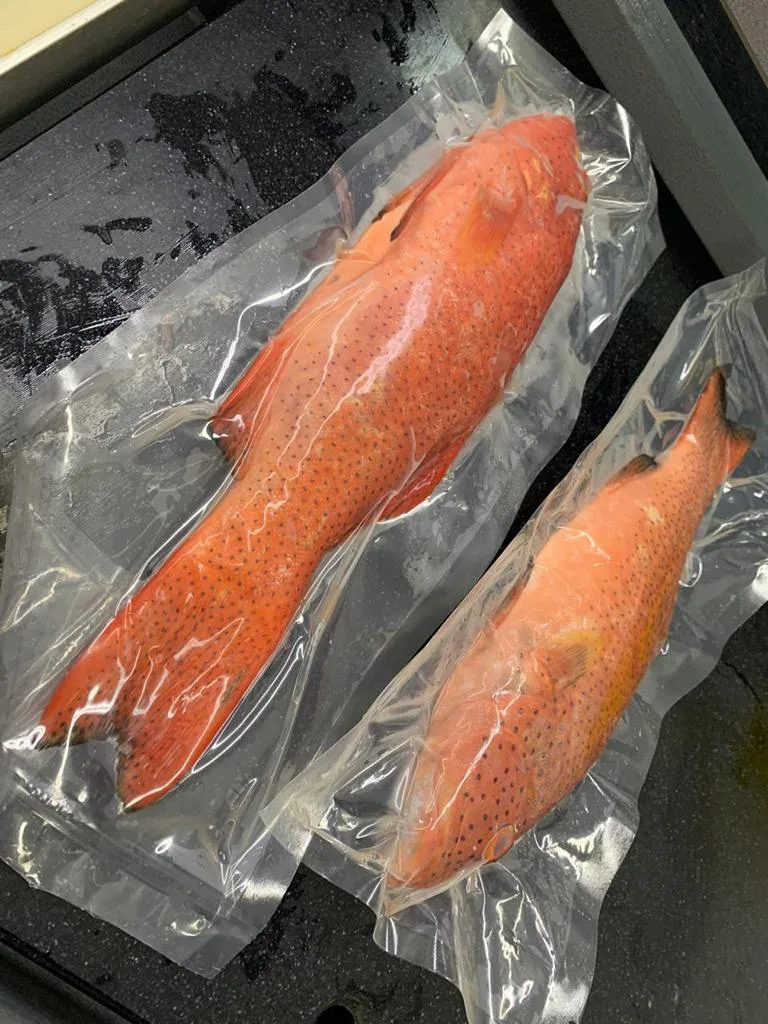
Red Grouper — known in Chinese as 红石斑鱼 (hóng shí bān yú) or 东星斑 (dōng xīng bān) — is widely regarded as the most prestigious grouper species in East Asian cuisine. It is characterized by a deep red-orange body with scattered white spots, firm white flesh, and a delicate sweetness that sets it apart from other grouper species.
Biological profile:
- —Scientific name: *Epinephelus akaara*
- —Market weight range: 400g – 2kg (optimum export grade: 600g–1.2kg)
- —Source: Wild-caught, primarily from South Sulawesi, Maluku archipelago, and Eastern Indonesian waters
- —Flesh: Fine-grained, firm, sweet flavor with low fat content
- —Availability: Seasonal — peak supply Q1 and Q3; limited in Q2 and Q4
Market positioning: Red Grouper is the benchmark species for live reef fish trade across Hong Kong, Guangdong, and Taiwan. According to Singapore Fish Files: Groupers — ieatishootipost, red grouper is consistently rated among the top-tier grouper species for texture and flavor, particularly in steamed preparations.
Price range (FOB Jakarta/Surabaya):
- —Live: USD 20–35/kg (market-dependent; premium for 600g–800g size)
- —Fresh-chilled whole: USD 12–18/kg
- —IQF frozen (whole/gutted): USD 8–12/kg
Flower Grouper (Epinephelus polyphekadion)
Flower Grouper — 花石斑 (huā shí bān) or 老虎斑 (lǎo hǔ bān) in Cantonese trade — is distinguished by its striking pattern of dark brown or black spots on a pale background. This visual appeal makes it a standout species in live fish displays at wet markets and premium restaurant tanks.
Biological profile:
- —Scientific name: *Epinephelus polyphekadion*
- —Market weight range: 500g – 3kg (optimum: 800g–1.5kg)
- —Source: Wild-caught and some aquaculture, South China Sea and Eastern Indonesian waters
- —Flesh: Slightly softer than Red Grouper, rich flavor, excellent for steaming and braising
- —Availability: Moderate seasonality; more stable than Red Grouper due to broader habitat range
Market positioning: Flower Grouper performs exceptionally well in markets where visual presentation drives purchase decisions — particularly Hong Kong wet markets, Guangdong restaurants, and Southeast Asian premium dining. Its spotted pattern makes it immediately recognizable to buyers.
Price range (FOB Jakarta/Surabaya):
- —Live: USD 14–22/kg
- —Fresh-chilled whole: USD 9–14/kg
- —IQF frozen (whole/gutted): USD 6–10/kg
Dragon Tiger Grouper (Hybrid: *E. lanceolatus* × *E. fuscoguttatus*)
Dragon Tiger Grouper — 龙虎斑 (lóng hǔ bān) — is a first-generation hybrid between Dragon Grouper (Giant Grouper, *Epinephelus lanceolatus*) and Tiger Grouper (*Epinephelus fuscoguttatus*). Developed through controlled aquaculture breeding programs in Southeast Asia, this hybrid was engineered specifically for commercial production: faster growth cycle, efficient feed conversion, and predictable sizing.
Biological profile:
- —Scientific name: *Epinephelus lanceolatus* × *Epinephelus fuscoguttatus* (F1 hybrid)
- —Market weight range: 600g – 5kg+ (very flexible sizing for foodservice)
- —Source: 100% aquaculture — certified farms in Java, Sulawesi, and Sumatra
- —Flesh: Denser than both parent species, mild flavor with firmer texture suited for high-heat cooking
- —Availability: Year-round, consistent supply from aquaculture operations
Market positioning: Dragon Tiger Grouper is the preferred choice for large-volume buyers — hotel groups, restaurant chains, supermarket seafood counters, and institutional foodservice. Consistent sizing allows precise portion control and menu pricing.
Price range (FOB Jakarta/Surabaya):
- —Live: USD 10–16/kg
- —Fresh-chilled whole: USD 7–11/kg
- —IQF frozen (whole/fillet/portion-cut): USD 5–8/kg
Side-by-Side Comparison: Which Grouper to Import from Indonesia?
| Parameter | Red Grouper | Flower Grouper | Dragon Tiger Grouper |
|---|---|---|---|
| Scientific name | *E. akaara* | *E. polyphekadion* | *E. lanceolatus × E. fuscoguttatus* |
| Source | Wild-caught | Wild-caught / some aquaculture | 100% aquaculture |
| Live export price | USD 20–35/kg | USD 14–22/kg | USD 10–16/kg |
| IQF frozen price | USD 8–12/kg | USD 6–10/kg | USD 5–8/kg |
| Flesh texture | Firm, fine-grained | Medium-firm, rich | Dense, mild |
| Visual distinctiveness | Deep red/orange | Bold spot pattern | Blotched/hybrid appearance |
| Sizing consistency | Variable (wild) | Variable (wild) | Highly consistent (farmed) |
| Supply reliability | Seasonal | Moderate | Year-round |
| Best market segment | Premium live fish, fine dining | Wet market, premium restaurant | Foodservice, supermarket, bulk |
| MOQ (live/fresh air) | 500kg | 500kg | 500kg |
| MOQ (IQF reefer) | 3MT | 3MT | 3MT |
grouper species Indonesia comparison: Market Demand by Region
Different importing regions have distinct preferences, and aligning species selection with destination market is critical to maximizing sell-through.
Hong Kong & Guangdong (China)
The live reef fish trade in Hong Kong is dominated by Red Grouper and Flower Grouper. Buyers in this market prioritize live-to-table freshness and are willing to pay a significant premium for live fish over fresh-chilled. Dragon Tiger Grouper has gained traction in mid-tier restaurant channels due to its price competitiveness.
Singapore & Malaysia
Singapore's premium seafood restaurants and hawker culture support all three species, with Flower Grouper particularly popular for zi char-style cooking. Dragon Tiger Grouper is widely used in hotel banquets and catering operations.
Taiwan
Taiwan is a strong Red Grouper market, with local consumers highly familiar with the species and willing to pay premium prices for fish from Eastern Indonesian waters. IQF frozen Red Grouper also moves well through supermarket chains.
Middle East & Europe
These markets predominantly import IQF frozen product. Dragon Tiger Grouper's consistent portioning makes it the most practical species for these channels. Halal certification (MUI) is a hard requirement for all Middle Eastern buyers.
red grouper flower grouper difference: Quality Grading & Cold Chain
Grading Standards
For live and fresh-chilled grouper, Indonesian exporters typically apply the following grading tiers:
- —Grade A (Premium): Zero injuries, full scale integrity, active swimming (live), clear eyes, bright gill color
- —Grade B (Standard): Minor scale damage acceptable, less active but healthy (live), suitable for fresh-chilled
- —Grade C (Processing): Visible injuries or scale loss, diverted to IQF frozen processing
For IQF frozen, grading focuses on glaze percentage (12–18% standard for export), core temperature (-18°C or below), and absence of freezer burn.
Cold Chain Requirements by Product Form
- —Live grouper: Oxygenated tank transport from harvest; air freight only; 24–36 hour delivery window; 100% inspection at destination
- —Fresh-chilled: 0–2°C throughout; Styrofoam-insulated cartons with gel ice; air freight; 48-hour maximum transit
- —IQF frozen: -18°C from processing to reefer container; 20ft reefer at -18°C setpoint; temperature recorder mandatory
For a detailed breakdown of cold chain standards from harvest to destination port, see our Cold Chain Logistics for Indonesian Seafood Exports guide.
which grouper to import Indonesia: Certification Checklist
All three species require the same core certification set for export from Indonesia:
| Certification | Purpose | Issuing Body |
|---|---|---|
| HACCP | Food safety management system | KKP (Ministry of Marine Affairs & Fisheries) |
| BRC Grade A | British Retail Consortium food safety | BRC Global Standards |
| Halal MUI | Islamic halal certification | Majelis Ulama Indonesia |
| Health Certificate | Export clearance per shipment | BKIPM Indonesia |
| CITES (if applicable) | Species protection compliance | CITES secretariat via KKP |
> Note on CITES: Red Grouper (*E. akaara*) is not currently listed under CITES appendices, but buyers sourcing from regions with conservation concerns should verify the most current listing status with their import authority.
For a complete breakdown of certification requirements and how to verify them independently, see our How to Import Premium Grouper from Indonesia guide.
Pricing Trends and Supply Factors
Wild-Caught Species (Red Grouper, Flower Grouper)
Wild-caught grouper prices are subject to seasonal variation driven by monsoon fishing restrictions, regional catch quotas, and live fish tank mortality rates during transit. Indonesian fisheries implement a seasonal fishing ban (closed season) in certain areas during Q2 to protect breeding stocks, which reduces supply and drives price increases.
Aquaculture Species (Dragon Tiger Grouper)
Dragon Tiger Grouper pricing is more stable due to controlled aquaculture production cycles. Price movements are primarily driven by feed cost (fishmeal and pellet ingredients) and energy costs at hatchery operations. Year-round supply means buyers can negotiate annual supply contracts with fixed pricing tranches.
FOB Price Benchmarks (Q3 2026)
| Species | Live (per kg) | Fresh-Chilled (per kg) | IQF Frozen (per kg) |
|---|---|---|---|
| Red Grouper | USD 20–35 | USD 12–18 | USD 8–12 |
| Flower Grouper | USD 14–22 | USD 9–14 | USD 6–10 |
| Dragon Tiger Grouper | USD 10–16 | USD 7–11 | USD 5–8 |
*Prices are indicative FOB Jakarta/Surabaya. Actual pricing depends on size grade, volume, and market conditions at time of order.*
FAQ
What is the difference between red grouper and flower grouper?
Red Grouper (*Epinephelus akaara*) has a deep red-orange body and is prized for its firm, sweet flesh — it commands the highest price in live fish markets. Flower Grouper (*Epinephelus polyphekadion*) has a bold spotted pattern and a richer flavor profile, making it a top choice for wet markets and premium restaurants in Hong Kong and Guangdong. Red Grouper is generally 20–40% more expensive than Flower Grouper at equivalent size grades.
Which Indonesian grouper is the most valuable?
Red Grouper consistently commands the highest price per kilogram across all product forms — particularly as live fish for East Asian markets. At peak season, live Red Grouper from Eastern Indonesian waters can reach USD 35/kg FOB, nearly double the price of Dragon Tiger Grouper at equivalent weight.
Is Dragon Tiger Grouper a naturally occurring species?
No. Dragon Tiger Grouper is a controlled F1 hybrid produced through aquaculture breeding programs by crossing Dragon Grouper (*Epinephelus lanceolatus*) with Tiger Grouper (*Epinephelus fuscoguttatus*). It does not occur in the wild. Its primary advantage is a faster growth cycle (market weight in 8–12 months vs. 18–24 months for wild-caught equivalents) and highly consistent sizing.
What is the minimum order quantity for Indonesian grouper export?
For live and fresh-chilled grouper, the minimum order quantity is typically 500kg per air freight shipment. For IQF frozen grouper, the standard MOQ is 3MT per 20ft reefer container. Mixed-species containers are available from 5MT total.
Do all three grouper species require the same certifications for export?
Yes. HACCP (KKP), BRC Grade A, Halal MUI, and a Health Certificate from BKIPM are required for all grouper species exported from Indonesia regardless of product form. Buyers in the EU should additionally request EU-approved establishment number confirmation from the processing facility.
*TaMainco exports all three grouper species — Red, Flower, and Dragon Tiger — in live, fresh-chilled, and IQF frozen form. Our processing facility in Surabaya holds BRC Grade A and HACCP certification. For current FOB price lists and stock availability, contact us via WhatsApp or send an email inquiry.*
红石斑 vs 花石斑 vs 龙虎斑印度尼西亚:完整对比指南
红石斑、花石斑和龙虎斑是印度尼西亚三大主要出口石斑鱼品种。红石斑活鱼价格最高(离岸价每公斤20–35美元),花石斑是香港和广东湿货市场的首选,龙虎斑则以均匀规格和具竞争力的价格满足大批量餐饮买家需求。
> 核心要点
> - 红石斑 = 最高溢价,最适合活鱼贸易和高端餐厅
> - 花石斑 = 视觉吸引力强,适合湿货市场和精品餐饮
> - 龙虎斑 = 规格均匀,全年供应,性价比最佳
> - 三种品种均可提供活鱼、冰鲜和IQF冻品
> - 野生捕捞品种(红石斑、花石斑)价格波动较大;龙虎斑为养殖品种,供应稳定
品种概览:核心差异一览
了解三种石斑鱼品种的核心差异,是将供应与市场需求精准匹配的第一步。
红石斑(Epinephelus akaara)
红石斑——中文称"红石斑鱼"或"东星斑"——在东亚美食中被公认为最顶级的石斑鱼品种。其特征为深红橙色鱼体、散布白色斑点、肉质紧实洁白,具有独特的清甜鲜味。
生物学特征:
- —学名:*Epinephelus akaara*
- —市场规格范围:400g–2kg(最优出口等级:600g–1.2kg)
- —产地:野生捕捞,主要来自南苏拉威西、马鲁古群岛和印尼东部水域
- —肉质:纹理细腻、质地紧实、味道鲜甜、脂肪含量低
- —供应季节性:季节性明显——Q1和Q3供应高峰;Q2和Q4供应有限
花石斑(Epinephelus polyphekadion)
花石斑——粤语贸易中称"老虎斑"——以浅色底上密布深褐色或黑色斑点的独特花纹为标志。这种视觉吸引力使其在湿货市场活鱼展示和高端餐厅鱼缸中极为抢眼。
生物学特征:
- —学名:*Epinephelus polyphekadion*
- —市场规格范围:500g–3kg(最优:800g–1.5kg)
- —产地:野生捕捞及部分养殖,南海和印尼东部水域
- —肉质:略软于红石斑,味道浓郁,适合清蒸和红烧
- —供应季节性:季节性中等;因栖息地范围更广,供应较红石斑稳定
龙虎斑(杂交:龙胆石斑 × 老虎斑)
龙虎斑是龙胆石斑(*Epinephelus lanceolatus*)与老虎斑(*Epinephelus fuscoguttatus*)的一代杂交品种,通过东南亚受控养殖育种计划培育而成,专为商业化生产设计:生长周期更快、饲料转化率高、规格可预测。
生物学特征:
- —学名:*Epinephelus lanceolatus* × *Epinephelus fuscoguttatus*(F1杂交种)
- —市场规格范围:600g–5kg以上(餐饮规格灵活)
- —产地:100%养殖——爪哇、苏拉威西和苏门答腊认证养殖场
- —肉质:较两亲本品种更为致密,口味温和,适合高温烹饪
- —供应季节性:全年供应,养殖场产量稳定
并排对比:从印度尼西亚进口哪种石斑鱼?
| 参数 | 红石斑 | 花石斑 | 龙虎斑 |
|---|---|---|---|
| 学名 | *E. akaara* | *E. polyphekadion* | *E. lanceolatus × E. fuscoguttatus* |
| 货源 | 野生捕捞 | 野生捕捞/部分养殖 | 100%养殖 |
| 活鱼出口价 | 20–35美元/kg | 14–22美元/kg | 10–16美元/kg |
| IQF冻品价 | 8–12美元/kg | 6–10美元/kg | 5–8美元/kg |
| 肉质 | 紧实、纹理细腻 | 中等紧实、味道浓郁 | 致密、口味温和 |
| 视觉辨识度 | 深红/橙色 | 醒目斑点花纹 | 杂交外观 |
| 规格一致性 | 不稳定(野生) | 不稳定(野生) | 高度一致(养殖) |
| 供应可靠性 | 季节性 | 中等 | 全年 |
| 最适市场 | 高端活鱼、精品餐厅 | 湿货市场、高端餐厅 | 餐饮、超市、大批量 |
| 最低订购量(活鱼/冰鲜空运) | 500kg | 500kg | 500kg |
| 最低订购量(IQF冷藏集装箱) | 3MT | 3MT | 3MT |
Ready to place an order?
Contact us for current pricing, availability, and samples.
联系我们获取当前报价、库存及样品